


art as biography
- shonahescombe
- May 31, 2023
- 9 min read


“Biographical" conceptual art refers to works that have some grounding in the artist's personal experiences, memories, and identity. Autobiographical art often involves the use of personal elements, such as private experiences, photographs, and found objects. These items are used to explore themes which relate to the self, identity, memory, and history.
Autobiographical art can generate a sense of personal connection between the artist and the viewer. The viewer may see aspects of their own experiences or emotions reflected in the work, which can create a sense of empathy and understanding with the artist. The art can feel meaningful and authentic as it draws from the artist's own life story, this can produce a sense of trust and intimacy between the artist and the viewer. For the artist themselves the art can be a form of emotional release and by exploring their own experiences and emotions through their art, the artist can process and make sense of their own feelings. Furthermore, by sharing their own experiences and perspectives, the artist can shed light on broader social issues and create a platform for dialogue and change.
Much of my recent work is autobiographical, it includes artefacts, experiences, and emotions from my own experience. I have found that the work which I have been producing has a theme of loss and grieving for past relationships and for close family members. I have been looking at some well-known artists and how they approach art in relation to their life, personality, and emotion. Looking at the direct connection between the artist and their art, how they incorporate elements of their own life stories into their artwork and that they use their personal experiences as a means of exploring social and political themes.
There are many artists who have incorporate biographical elements into their work, one that comes to mind is Frida Kahlo (1907-1954). Kahlo was a Mexican painter who is known for her vibrant, surrealist self-portraits which often incorporated elements of her life. This includes her physical pain, her relationships, and her Mexican heritage, bringing in her experiences as a Mexican woman. Her paintings are often considered to be autobiographical in nature, as they reflect her personal experiences and struggles.

Thinking about death by Frida Kahlo (1943) - [i]
Distinctively this is Frida Kahlo’s work as it is full of symbolisation and intense emotions. It feels like she is showing her preoccupation with death after her accident left her with issues standing and sitting for any length of time. She must have been in a huge amount of pain – but the face has an expression of sereness and acceptance.
An artist who used biographical references to create more contemporary art is Mary Kelly (1941) in her post-partum document work (1973-1979). This is a series of conceptual art pieces that she created in the late 1970s, after the birth of her son. This work reflects her experiences of motherhood and the physical, emotional, and social changes that come with it. The work consists of panels covered in various materials and text that Kelly transcribed from her daily experiences as a new mother. It includes descriptions of her son's activities, her own emotional state, and her struggles to balance her roles as mother and artist.

Post-Partum Document by Mary Kelly (1978) [ii]
Overall, Mary Kelly's post-partum work is a powerful and thought-provoking exploration of the experiences of motherhood and the ways in which they shape our sense of self and identity. The work has had a profound influence on the development of biographical art, as well as on feminist theory and practice. Using her personal objects, she is describing her personal response to her experiences in motherhood and the relationship between mother and child.
In the 1980s-1990s the AIDS epidemic led to a rise in biographical art that explores the experiences of people living with HIV/AIDS, as well as the experiences of their friends and families. One of those artists was Felix Gonzalez-Torres (1957-1996). He was an artist who is well known for his autobiographical artworks that reflect on his personal life experiences, his cultural identity as a Cuban American, and his experience of living with HIV/AIDS. Many of his works use simple everyday materials and objects to explore themes of love, loss, and identity. One of his works is "Untitled" (Portrait of Ross in L.A.), which is a large pile of individually wrapped sweets that weighs the same as Gonzalez-Torres's partner, Ross Laycock, who died of AIDS-related complications in 1991.

"Untitled" (Portrait of Ross in L.A.) by Felix Gonzalez-Torres 1991 [iii]
This piece almost feels like Felix is blaming the public and society for his partners death, as pieces of the installation are taken by the public the body weight of his partner is diminished, this happened to his partner through the ravages of the HIV infection which he had contracted during the AIDS epidemic. It feels like quite a traumatic piece for the viewer as the weight of the pile of sweets reduces with people picking up the sweets (and presumably eating and enjoying them). The installation is almost a performance art as the pile was continuously replenished as per his instructions to give his partner eternal life.
“Above all else, it is about leaving a mark that I existed: I was here. I was hungry. I was defeated. I was happy. I was sad. I was in love. I was afraid. I was hopeful. I had an idea, and I had a good purpose and that's why I made works of art.” (“Quote by Felix Gonzalez-Torres: “Above all else, it is about leaving a ...”)
Additionally, his work "Untitled" (billboard of an empty bed) he created a quiet yet haunting billboard installation. This is the year he lost his lover of eight years, Ross Laycock, to an AIDS-related illness. The massive image of the empty bed conjures associations of rest, desire, death, and loneliness, as a place of intimacy and comfort is suddenly transformed into a space of isolation. Gonzalez-Torres mounted the image on 24 billboards to commemorate the day his love died.

“Untitled" (billboard of an empty bed) by Felix Gonzalez-Torres 1991 [iv]
To me these billboards feel very evocative of loneliness and loss, the image is stark and the impression of the heads on the pillow suggests a recent presence. It speaks of a personal tragedy and a very personal loss which he displayed in a very public place. A bed should be a place of comfort but has now become a reminder of a lost love, this feels powerful and sad with the absence of what was. His works are deeply personal and emotionally charged, inviting viewers to engage with their own experiences of love, loss, and identity.
“Left Behind" (2014) is a series of artworks by Jennifer Loeber that intimately explores the theme of loss and absence through the representation of personal abandoned, inherited, and discarded objects. The series consists of photographic prints and installations of found objects such as jewellery, makeup, sunglasses, and clothing, which are arranged in a way that suggests a human presence or absence.
“When my mom died suddenly in 2013, I found myself overwhelmed by the need to keep even the most mundane of her belongings. But instead of providing comfort, they became a source of deep sadness and anxiety. The only way I could imagine moving past it all was to focus on how to interact with these objects cathartically.”
Jennifer Loeber 2014
The artworks in "Left Behind" convey a sense of melancholy and nostalgia, as the objects depicted are no longer valued or useful, and have been left behind by their owners. By photographing these discarded objects and arranging them in a way that suggests a human presence, Loeb creates a poignant meditation on loss and absence, and the ways in which our physical surroundings can reflect our emotional states.
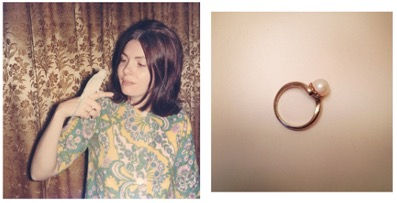
"Left Behind" by Jennifer Loeber (2014) [v]
I found this piece very emotional as I put a lot of someone’s personality into their possessions, no matter how small or “unvaluable” they may appear to an outsider. Everyday items can bring back memories, prove the existence of that loved one and put us in a certain time and a place. Following on from that, the items can then become painful reminders of the fact that that person is no longer here.
Looking at pieces which I have created and specifically those which fall into biographical art practice, they have a similar theme of lost loved ones and the feeling when someone or something that we love leaves us. This loss can be through death or absence, and we are left with their remnants which could be a physical object, a memory or something else which is immaterial. The artists which I have chosen above have taken these remnants, which often have a subjective meaning, to create art for public viewing and making themselves into the survivors and possibly the memory-keepers. Through the art and creative process, I am creating a space for myself to grieve for a loss, but also passing on that grief and grieving process to the viewer. The creation of the art itself may also be cathartic to assist with my own grieving process, but also, I am hopeful of keeping the memory of the person alive through the works.

Her Letter, Her Words, Her Words by Shonah Escombe (2023)
When I was recently re-reading the letters, I received from my mum whilst I was travelling in the 1990s, they invoked an emotional response in me. I felt like I could hear her voice from all those years ago with her way of writing, punctuation, underlining, little drawings etc. These letters I received have now become precious to me, not so much for what is written, as this is mostly the day-to-day stuff going on in her life, but more because they are something that I can physically hold as a reminder of her. I can safely say that they mean more to me today than when I received them as I can imagine and appreciate the love and kindness behind the act of writing those letters. The artefact she left with me is her handwriting and although this is a very personal piece to me, I hope the audience will be nudged into thinking about what has been lost and what has been gained by the way we communicate today.

Inheritance by Shonah Escombe (2021)
This oil painting is called Inheritance and is a lightly textured painting of items which I inherited following my dad’s death when we were clearing out my parent’s house. Included are his watch box, a bottle of ancient beer from where he used to work and a “stubby” pencil from his time as a joiner. The handwriting which is collaged onto the canvas is a mixture of sentences from my dad’s retirement speech and the words in the eulogy I read at his funeral. The items and the words have many personal memories, and I was hoping the audience may think about what precious items and memories are left to us by loved ones. Inheritance need not be money and possessions of financial value but also small items which bring them back to mind.

Ties that Bind Us by Shonah Escombe (2022)
This piece was created to show how generations of families are connected not only to the past but to the future parts of the family. The family photographs are mounted on felt and textured Tyvek paper. There is also stitching to connect the families and wire connects the panels.
Overall, biographical artists use their personal experiences as a means of exploring broader social and political issues by creating work that is both deeply personal and universal in its themes. Autobiographical art can carry a deep emotional weight because it is often a reflection of the artist's personal experiences, emotions, and struggles. When an artist creates work that draws from their own life story, it can create a sense of authenticity and vulnerability that can resonate with viewers on a deeper emotional level. Drawing on life experience the artist can create a powerful emotional impact that can resonate with viewers long after they have experienced the work.
-------------------- END --------------------
Bibliography (Alphabetical Order)
agora.unicef.org. (n.d.). Summary of Before I die, I want to... [online] Available at: https://agora.unicef.org/course/info.php?id=1619 [Accessed 20 Apr. 2023].
Anon, (n.d.). Candy Chang» Before I Die. [online] Available at: https://candychang.com/work/before-i-die-in-nola/ [Accessed 26 Apr. 2023].
Brokenships. (n.d.). Brokenships. [online] Available at: https://brokenships.com/explore [Accessed 26 Apr. 2023].
Colossal. (2012). Return to the Sea: Saltworks by Motoi Yamamoto. [online] Available at: https://www.thisiscolossal.com/2012/08/return-to-the-sea-salt-labyrinths-poured-by-motoi-yamamoto/ [Accessed 20 Apr. 2023].
Findley, J. (2018). FRAGMENTATION: MATERIALISING MOURNING FROM COMPLICATED GRIEF. [online] Available at: https://researchonline.rca.ac.uk/3465/1/Jules%20FIndlay%20PhD%20Thesis.pdf [Accessed 26 Apr. 2023].
Fridakahlo.org. (2009). Thinking about death - by Frida Kahlo. [online] Available at: https://www.fridakahlo.org/thinking-about-death.jsp [Accessed 26 Apr. 2023].
HuffPost UK. (2014). One Daughter’s Response To Her Mother’s Death, Captured In Stunning Keepsake Photos. [online] Available at: https://www.huffingtonpost.co.uk/entry/jennifer-loeber-left-behi_n_5481481?ncid=fcbklnkushpmg00000027 [Accessed 26 Apr. 2023].
HuffPost UK. (2015). A Brief History Of Creative People Grappling With Loss And Death Through Art. [online] Available at: https://www.huffingtonpost.co.uk/entry/death-in-art_n_6849376 [Accessed 26 Apr. 2023].
Korducki, K. (n.d.). Moving through Grief. [online] Canadian Art. Available at: https://canadianart.ca/essays/art-and-grief/ [Accessed 26 Apr. 2023].
MoMA (2019). MoMA. [online] MoMA. Available at: https://www.moma.org/ [Accessed 26 Apr. 2023].
NPR.org. (n.d.). Artist Explores Grief, Memory And Loss Through Photographs. [online] Available at: https://www.npr.org/sections/pictureshow/2020/04/27/830806858/artist-explores-grief-memory-and-loss-through-photographs [Accessed 26 Apr. 2023].
researchonline.rca.ac.uk. (n.d.). Archive of research processes and output produced by RCA - RCA Research Repository. [online] Available at: https://researchonline.rca.ac.uk/ [Accessed 20 Apr. 2023].
the Guardian. (2015). Mexico’s street art tells stories of grief, anger, and resistance | Sam Jones. [online] Available at: https://www.theguardian.com/global-development/2015/feb/05/mexico-oaxaca-murals-lapiztola-street-art-murals [Accessed 26 Apr. 2023].
Tim McLaughlin. (n.d.). The Art of Loss. [online] Available at: https://tmcl.ca/posted/2018/10/11/the-art-of-loss [Accessed 26 Apr. 2023].
University of Brighton. (n.d.). Art and grief. [online] Available at: https://www.brighton.ac.uk/caw/what-we-do/projects/art-and-grief.aspx [Accessed 26 Apr. 2023].
www.wikiart.org. (n.d.). Felix Gonzalez-Torres - 19 artworks - installation. [online] Available at: https://www.wikiart.org/en/felix-gonzalez-torres/ [Accessed 26 Apr. 2023].
[i] www.fridakahlo.org. (n.d.). Thinking about death - by Frida Kahlo. [online] Available at: https://www.fridakahlo.org/thinking-about-death.jsp#:~:text=During%20the%20later%20years%20of [Accessed 31 May 2023]. [ii] marykellyartist.com. (n.d.). POST-PARTUM DOCUMENT, 1973-79. [online] Available at: https://www.marykellyartist.com/post-partum-document-1973-79 [Accessed 31 May 2023]. [iii] Art Institute Chicago (n.d.). ‘Untitled’ (Portrait of Ross in L.A.). [online] The Art Institute of Chicago. Available at: https://www.artic.edu/artworks/152961/untitled-portrait-of-ross-in-l-a [Accessed 31 May 2023]. [iv] Folland, Dr.T. (2015). Felix Gonzalez-Torres, ‘Untitled’ (billboard of an empty bed) – Smarthistory. [online] smarthistory.org. Available at: https://smarthistory.org/felix-gonzalez-torres-untitled-billboard-of-an-empty-bed/ [Accessed 31 May 2023]. [v] JENNIFER LOEBER. (n.d.). Left Behind. [online] Available at: http://www.jenniferloeber.com/left-behind [Accessed 31 May 2023].


Comments